

The AI Experimentation Trap
Organisations are drowning in AI pilots, whilst capability remains zero

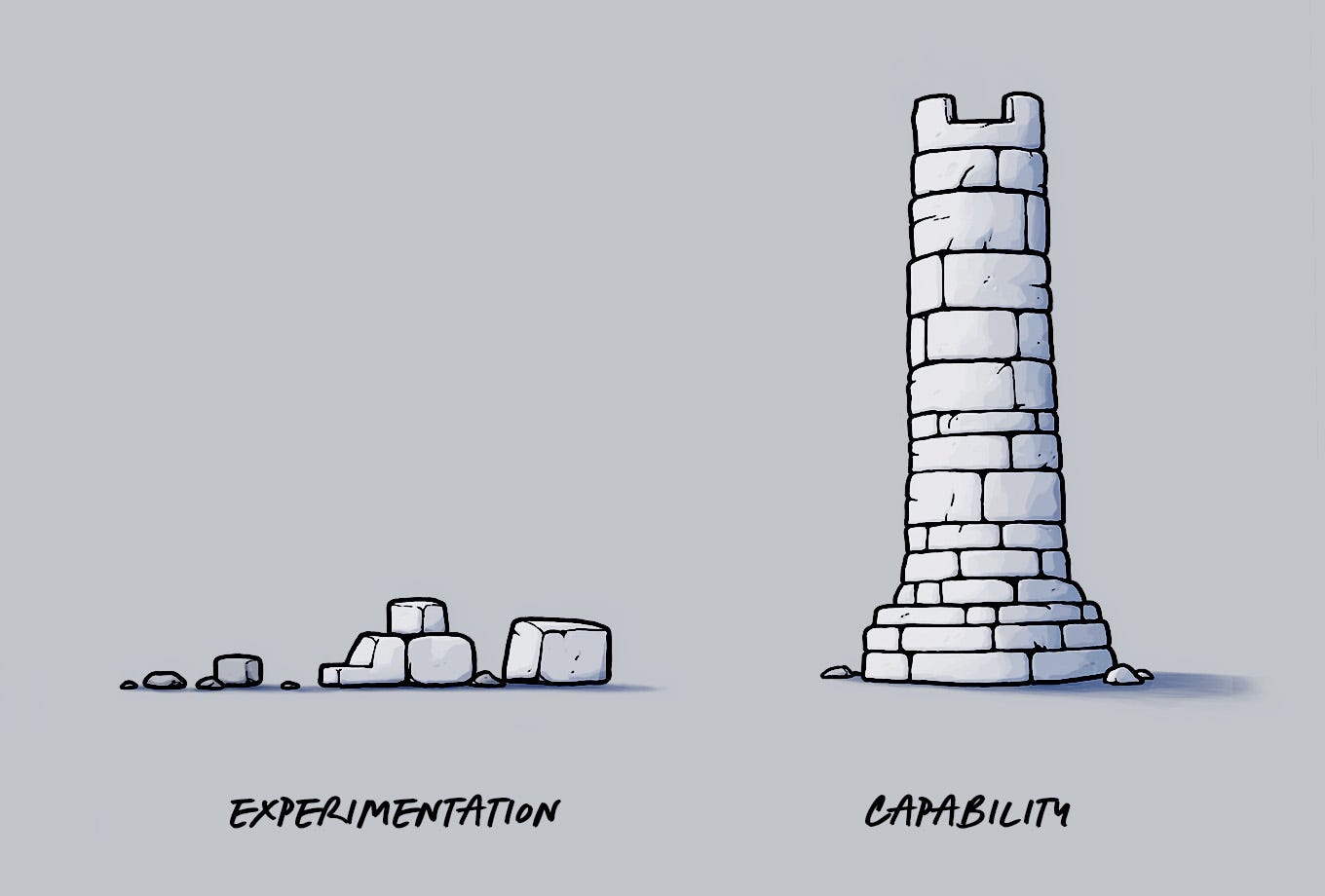
When it comes to AI, most large organisations are solving the wrong problem.
They’re treating AI as a technology challenge when it’s a leadership challenge. That’s why the pilots multiply but the capability stays flat. The strategy exists, but execution doesn’t. And why everyone’s busy, but nothing’s moving.
The pattern repeats across sectors.
A large tech company runs twelve AI pilots in marketing. None has become standard practice. A public sector organisation spends a year on AI governance frameworks, whilst frontline staff quietly use the tools to get their work done. A law firm debates AI ethics for six months whilst trainees use Claude to draft contracts nobody reviews.
In higher education, it looks like this: Universities are running AI pilots, writing strategy documents, and appointing transformation leads. Lots of activity. Almost no capability. The experimentation trap means endless trials that never become institutional practice because no one has built the leadership capability to make them stick.
72% of English universities are projecting deficits for next year whilst 92% of their students are already using AI independently.
The institutions can’t decide if AI is a threat or a lifeline, so they’re treating it as a technology problem. Forming committees. Briefing procurement. Talking to vendors. Writing policies. All the things that look like leadership but aren’t.
The actual constraint isn’t technology. It’s capability. McKinsey’s research shows that only 1% of organisations describe their AI rollouts as mature. The single biggest predictor of success isn’t budget or infrastructure. It’s whether senior leaders personally use the tools themselves. Not sponsoring initiatives from a distance, actually getting their hands dirty.
This matters because the cultural shift required to build AI capability is exactly the shift large organisations have been struggling with for years.
Distributed leadership, horizontal thinking and moving away from protective hierarchies towards genuine co-creation. These aren’t aspirations anymore. They’re survival requirements. And AI transformation demands precisely the kind of leadership most institutions haven’t yet developed.
For the past few months, my colleague Peter and I have been building something different. Not another framework to licence. Not a consulting engagement that creates dependency. A methodology for developing genuine organisational capability.
It’s called the AI Transformation Roadmap (AITR), and it’s applied creativity in action.
It’s built around a simple principle: make ourselves redundant.
It works with a client’s actual data, real organisational challenges and specific governance structures. Leaders use AI tools themselves. They build knowledge bases that capture organisational learning. They develop the judgement to evaluate vendor claims critically and make decisions with incomplete information. They learn to think on purpose, not just react on autopilot.
The frameworks and tools are explicitly designed for knowledge transfer. By the end of our time together, leadership teams can run their AI transformation initiatives without us. That’s not just the goal. It’s how we measure success.
This isn’t theory. I’ve spent more than three decades helping organisations navigate change, and Peter brings thirty years of strategic execution work. Between us, we’ve seen enough transformation efforts to know what works: building capability, not dependency. Teaching people to ask better questions, not providing perfect answers and creating conditions for genuine progress, not performance theatre.
We’re running a live webinar on November 28th. Not a sales pitch. A demonstration of how this works in practice. We’ll use a university scenario because higher education is facing this challenge acutely, but the methodology applies to any large organisation trying to build AI capability.
We’ll show our nine-domain framework in action, how to achieve governance transparency without bureaucracy, and how to build internal capability to lead AI transformation rather than being led by it.
If you’re leading transformation in any sector, or you’re simply curious to see what AITR looks like at an institutional scale, come along. No obligation, no hard sell, just a chance to see how the principles I’ve been writing about translate into practical organisational change.
From Assessment to Autonomy: Building AI Capability in Higher Education
Don’t worry if you can’t make it live, as the recording will be shared with all registrants.
The large organisations that will thrive—whether universities, professional services firms, healthcare systems, or tech companies—aren’t the ones with the biggest AI budgets or the most sophisticated technology. They’re the ones building genuine leadership capability to navigate continuous change without pretending they have all the answers.